Thursday, 10 January 2013

Playground Under Jakarta Flyovers


Sekelompok desainer di Jakarta bermufakat membuat sejumlah  tempat bermain untuk anak-anak di kolong jembatan layang. Apakah ini tindakan ilegal?

Dari perspektif hukum memang sudah pasti jawabannya ya, namun dalam pandangan moral dan kemanusiaan jelas tidak sama sekali!

Dari laporan DPP Asosiasi Pengembang Perumahan dan Pemukiman Seluruh Indonesia (Apersi) pada 2012,  masyarakat Jakarta yang berpenghasilan rendah menduduki peringkat kedua dari seluruh provinsi di Indonesia yang tidak memiliki rumah. Jumlahnya sekitar 5 juta jiwa.

Peringkat pertama dipegang oleh Jawa Barat, sementara yang ketiga disandang Jawa Timur. Kebanyakan masyarakat berpenghasilan rendah di Jakarta tinggal dengan menyewa rumah atau mengontrak. Yang lainnya, harus menerima nasib hidup di area tidak layak, seperti kolong jembatan dan kawasan kumuh.

Mereka tidak sanggup membeli rumah susun. Daya belinya belum sampai. Di sisi lain, kalah bersaing dengan pembeli yang tujuannya investasi dengan “mengakali” peraturan perundangan pemerintah daerah.

Dari kenyataan tersebut, bagaimana kita berharap anak-anak bisa tumbuh sehat jiwa dan raganya apabila melalui masa kecilnya tinggal  di kolong jembatan?

Dari sanalah peran seni dan desain begitu penting untuk tidak sekedar eksis karena dikatakan artistik, namun sikap untuk berpihak dengan mengedepankan fungsi kemanusiaan bagi khalayak yang tak mampu.

Pada kasus ini, memberi tempat bermain berarti memberi kesempatan anak-anak di bawah kolong jembatan hidup lebih wajar. Bukankah, masa kanak-kanak adalah masa bermain dan bersenang-senang?

Pada akhir 2011, selama berbulan-bulan, para desainer yang menamakan dirinya kelompok Ambitexts: Jogjakarta Designer Consortium's  itu mengadakan riset dan berdiskusi dengan tim Kurator.

Mereka akhirnya membangun tempat bermain di tiga titik di bawah jembatan layang di lokasi yang berbeda di Jakarta, dimana banyak anak kecil dan orang tuanya atau keluarganya tinggal di bawah kolong jembatan.

Karya yang disebut BakDang (Jebakan Kandang) tersebut kemudian  menjadi bagian penting dari pergelaran out door zona seni publik di acara Jakarta Biennale#14, 2011 lalu.

A group of designers in Jakarta have agreed to create a playground for children under the flyover. Is this breaking the law?

From a legal perspective, surely the answer is yes, but in the view of humanity and morality is clearly not at all!

According to a report from the central bureau of  the Association of Indonesian Housing and Developers (Apersi) in 2012 approximately 5 million low-income people in Jakarta have no home.

Jakarta was ranked second of all provinces in Indonesia where people do not have homes. The first rank is held by the province of West Java, while the third carried the province of East Java.

Most low-income people in Jakarta living by renting houses. The others have to accept the fate of living in uninhabitable areas such as under flyovers and slums.

They can not afford to buy a flat. The purchasing power is still low. On the other hand, they are not able to compete with the buyer who has a goal to the investment and violate local laws.

From these facts, how could we expect children to grow both body and soul will be healthier if through their childhoods living under a flyover?

From the last point, the role of art and design is so important to not just exist because it says artistic. But it also is an attitude we are to stand for the function of art to humanity.

In this case, providing a place to play means allowing children to live under a bridge with a more feasible. People say that childhood is a time to play and have fun and they have the right to get it.

At the end of 2011, for months before, the designers who call themselves the Ambitexts: Jogjakarta Designer Consortium's researching and discussing with the team of curators.

They eventually built a playground under an overpass in three-point of different locations in Jakarta, where many children and their parents or their family living under a bridge.

The artwork is called BakDang-Jebak Kandang (The Cage of trap) was then an important part of out door zones of public art in the Jakarta Biennale # 14, 2011.


source: properti.kompas.com
             vivanews.com
             Ambitexts: Jogjakarta Designers Consortium's
             Jakarta Biennale#14, 2011
             SatuLingkar.com
             megapolitan.kompas.com

Tuesday, 1 January 2013

Jl.Tikus or Rat Alley in Jakarta


Jakarta diperkirakan para ahli lalu-lintas pada 2014 mungkin akan mengalami tahun terburuk menyoal kemacetan. Sama dengan kota-kota dunia yang masuk pada daftar “10 monster of traffic jams from around the world” versi BBC.


Kota-kota tersebut adalah Sao Paulo-Brazil, Bangkok-Thailand, Nairobi-Kenya, Manila-Philippines, Mumbai-India, Kampala-Uganda, Lexington, Kentucky-US, Austin, Texas-US, Seoul-South Korea, Dhaka-Bangladesh, Megeve - French Alps.

Anda bisa memaklumi jika 2014 terjadi titik jenuh kemacetan di Jakarta. Bayangkan, pertumbuhan jumlah kendaraan bermotor benar-benar tidak terkendali. Ada sekitar ± 8  juta unit kendaraan bermotor di Jakarta yang terdiri dari kendaraan pribadi sebanyak 98%  & angkutan umum hanya 2%. Pertumbuhan Mobil pribadi ± 250 unit/hari & Sepeda Motor ± 1000 unit/hari.

Jalan Tikus, gang tikus atau jalan alternatif yang biasanya kecil, dan terdapat ditengah-tengah wilayah kampung di kota Jakarta,  mungkin salah satu alternatif tercepat untuk sedikit “mengurai” kemacetan. Terutama bagi pengguna kendaraan sepeda motor.

Selain itu, tentu pemerintah Jakarta dan masyarakat musti berbenah diri dengan memperbaiki kualitas sistem transportasi massal dan berperilaku berkendara yang tertib. Ada satu PR bagi pemerintah, yakni secara resmi mengajak masyarakat kampung ditengah-tengah kota untuk ikut berpartisipasi secara langsung menyelesaikan persoalan kemacetan.

Hanya dengan kesadaran bersama akan menggerakkan pembenahan informasi tentang jalan tikus. Setidaknya pengguna jalan mendapatkan informasi lebih baik, sementara tidak pula  memberatkan masyarakat kampung.

Kemudian satu hal lagi, kapankah para pekerja kreatif dan para seniman segera berperan aktif dengan kekuatan mandiri di lingkungan kampung masing-masing? Membuat tanda-tanda lalu-lintas untuk informasi jalan tikus?


Jakarta has been predicted by traffic experts in 2014 may be having the worst year related to the problem of congestion.


It was similar to what happens in the cities of the world are included on the list of "10 monster of traffic jams from around the world" by BBC version.


These cities are Sao Paulo, Brazil, Bangkok, Thailand, Nairobi, Kenya, Manila, Philippines, Mumbai, India, Kampala, Uganda, Lexington, Kentucky, US, Austin, Texas, U.S, Seoul, South Korea, Dhaka, Bangladesh and Megeve, French Alps.

You can immediately understand in 2014 will be the peak of traffic congestion in Jakarta because the actual growth in the number of vehicles can not be controlled.

There are approximately ± 8 million units of vehicles in Jakarta consisting of as many as 98% of private vehicles and public transport is only 2%. The growth of private cars ± 250 units / day & motorcycles ± 1000 units / day.

Jl.Tikus (jalan tikus) or rat alley or “emergency road” were typically small and often located in the middle area of ​​the kampoong in the city. Maybe rat alley is one of the fastest alternative for at least " unravel congestion" in Jakarta, especially for users of motorcycles.

In the meantime, of course, the Jakarta government and road users should work together. The government immediately improve the quality of mass transit systems and people start driving properly in accordance with traffic regulations.

There is one more homework for the government which is formally they should invite the kampoong communities in the middle of the city to participate directly resolve the congestion problem.

Regarding rat alley, only by mutual consent will also move the distribution of information about the location where the rat alley can be accessed by road users. In this case, as long as not to burden  the kampoong comunities.

Finnaly, there is one thing that is still in our minds, when it's time for creative workers and artists will voluntary work on kampoong nearby to make traffic signs in providing information about the rat alley?

rat alley in kampoong 1

rat alley in kampoong 2

rat alley in kampoong 3

rat alley in kampoong 4                                                                                                                           
  •       
    concept design of  (jalan tikus) lewat sokin, bos by Selo Riesmulyadi


Source:
bbc.news.uk
Economic and Investment Advisor to the Ministry of Public Works Setiabudi Albamar
Tempo.co.id

Tuesday, 25 December 2012

Floating city and flooding in Jakarta


Sebagian warga kota Jakarta bisa dipastikan pada tiap bulan Desember sampai Februari selalu mendapat “kutukan tiap tahun”. Apalagi jika bukan banjir!

Wilayah di 78 titik rawan banjir dan masyarakat kampung di Jakartalah yang terkena dampak paling parah. Masyarakat yang lemah secara ekonomi dan akses politik. Sepertinya mereka menghadapi evil circle. Rantai yang sulit diputus dan buntunya jalan keluar.

Berbagai alasan dituding sebagai biang kerok terjadinya banjir. Mulai dari curah hujan yang tinggi, kurangnya daerah resapan air, pembangunan yang sewenang-wenang di hulu sungai, kebiasaan buruk masyarakat membuang sampah disungai, birokrasi pemerintah kota yang berbelit untuk segera bisa menyelesaikan perbaikan infrastruktur dengan membangun tanggul-tanggul sungai.

Masalah klasik yang berulang tiap tahun inilah yang menengok kita jauh ke negeri seberang sana, ke Belanda. Ke negara kampiun soal penanganan Banjir. Tentu saja selain kita tetap berharap pemerintah kota menyederhanakan birokrasi dalam pengelolaan sungai dan kampanye besar- besaran pada masyarakat untuk tidak “menyampah” di kali.

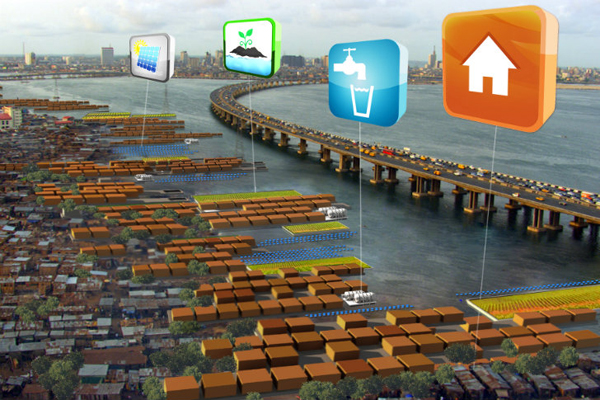
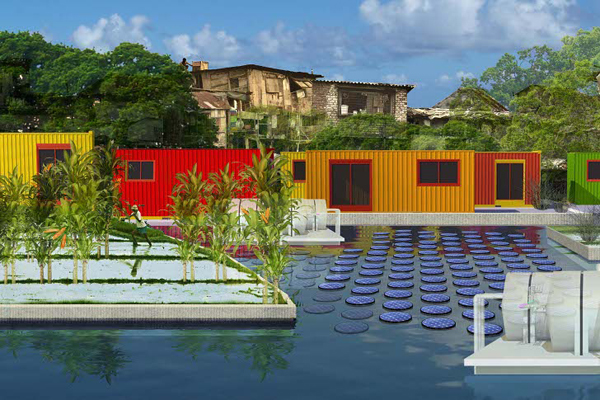
Baru-baru ini perusahaan desain Belanda bernama Waterstudio telah menciptakan serangkaian struktur terapung darurat yang bisa dibaringkan di sepanjang tepi "kampoong banjir" yang siap di uji coba di seluruh dunia. Mungkin saja termasuk Jakarta dalam daftar tunggu.

Rangkaian struktur tersebut bisa disebut sebagai "Kota terapung", yang akan mengambang dalam empat unit komposisi yang mampu menyediakan makanan, air, tempat tinggal, dan bahkan energi dalam keadaan darurat banjir.

Inovasi yang luar biasa ini diganjar penghargaan "Architecture & Sea Level Rise" dari Yayasan Jacques Rougerie. Desainernya menerima uang € 10.000. Cukup untuk membangun prototipe kota mengambang pertama di Bangladesh.

"Kampoong banjir" atau daerah yang berlangganan banjir, biasanya adalah lingkungan miskin, sering dibangun dengan berbagai bahan yang ditemukan di sekitar lokasi dan seadanya. 

Struktur ini bisa dengan mudah digeser, sepanjang wilayah yang terendam air. Selama curah hujan yang tinggi masyarakat kampoong memang seringkali dilumatkan oleh banjir, meninggalkan keluarga mereka yang menjadi jauh lebih menderita.

Aplikasi anyar dari desainer di  Waterstudio akan mengapungkan orang-orang di atas air dan menawarkan berbagai bentuk bantuan. Termasuk unit taman, sebuah pengolahan limbah tanaman yang dapat menyediakan air minum yang bersih dan limbah proses, unit perumahan yang juga dapat digunakan sebagai pusat masyarakat kampoong, sekolah, atau klinik, dan tempat panel energi surya untuk sementara.


Some residents in the city of Jakarta in December to February have always got "the curse of new year." It was flood that comes every year. There are 78 critical points of floods in Jakarta and kampoong communities most severely affected by floods.


People who are economically weak and do not have access to high-level political decision-makers facing an evil circle. A chain of interconnected that it is difficult to cut to find a way out.

Various reasons blamed as the root problem causing flooding. Starting from the high rainfall, lack of water catchment areas, urban development is not well planned in upper river areas also the bad habits of the people in Jakarta who throw garbage in the river.

The city government contributed to the error by running “a complicated bureaucracy” that has not been able to complete infrastructure improvements by building river embankments and better drainage system.

Those classic problems that happens every year was eventually turned our head to the Netherlands. The country that provides an expertise in dealing with flooding.

Of course, besides we still expect the city government to create a simple bureaucracy in dealing with issues of river management in Jakarta and starting a massive campaign on the people not to throw garbage in the river.

The Dutch design firm Waterstudio has created a series of floating emergency structures to lie along the edge of “wet slum kampoongs” all over the world. These floating “City Apps” come in four units that can provide food, water, shelter, and even energy in the event of a flooding emergency. 

This incredible innovation was recently awarded the “Architecture & Sea Level Rise” award from the Jacques Rougerie Foundation, earning the designers 10,000 euros—enough money to build the first prototype in Bangladesh

“Wet slum kampoongs” are impoverished neighborhoods, often built with make-shift materials, along a body of water. During periods of heavy rain, these communities are frequently destroyed by flooding, leaving families even more destitute. 

Waterstudio‘s new City Apps would float on top of the water and offer various forms of assistance. The units include a garden; a sewage treatment plant that can provide clean drinking water and process waste; a housing unit that can also be used as a community center, school, or clinic; and a solar panel array to temporarily power the area.


source: news.bbc.uk
           smh.au
           TEDxWarwick - Koen Olthuis - Floating City Apps.flv
           www.architizer.com
              kompas.com
              Kementerian Pekerjaan Umum Direktorat Jenderal Sumber Daya Air
              http://waterstudio.nl


Wednesday, 12 December 2012

Solar Bottle Lamps


Creativity is not the finding of a thing, but the making something out of it after it is found.

James Russell Lowell


Dari awal sampai pertengahan 2012 sesuai catatan Humas Polda Metro Jakarta ada 66 kasus kebakaran di Jakarta. 35 kebakaran diakibatkan karena korsleting listrik ketimbang ledakan kompor atau sebab lain.

Yang paling rentan adalah pemukiman padat penduduk yang banyak ditemukan instalasi listriknya tidak memenuhi standart. Kesembronoan pemasangan alat listrik.

Kenapa kita tidak mencontoh Filipina dalam hal ini? Selain mengkampanyekan pemakaian instalasi listrik dengan benar, juga memulai mengenalkan pada warga kampung-kampung kumuh yang padat penduduknya dengan sebuah terobosan: lampu botol surya!

Penggunaan lampu botol surya di siang hari di Filipina tujuan utamanya menolong masyarakat tidak mampu yang tinggal di wilayah padat pemukiman atau daerah belum mendapat akses listrik. Di Jakarta, bisa di coba untuk solusi pencegahan atau pengurangan kebakaran karena korsleting listrik di daerah kampung kumuh.

Lampu botol surya ini awalnya dikembangkan oleh mahasiswa MIT di Manila. 
Dengan hanya menggunakan botol plastik bekas yang telah diisi air, lampu botol surya siap digunakan. Sebelumnya, pemilik rumah harus rela melubangi bagian atap rumahnya seluas ukuran diameter botol plastik berisi air satu liter tersebut.

Untuk mengurangi terjadinya pertumbuhan jamur, lumut dan sebagainya, dituangkan sejumlah kecil larutan pemutih. Hasilnya lampu botol plastik tersebut akan memendarkan sinar matahari ke dalam rumah dengan cahaya yang setara dengan bola lampu listrik yang berkekuatan 55 Watt.


From early-mid 2012, the Public Relations of  Metro Police Jakarta  recorded 66 cases of fires and 35 fires caused by a short circuit instead of a stove explosion or other reasons.

The most sensitive exposed to fires is a densely populated residential and electrical installation not in accordance with the standard. A levity in the installation of electrical equipment.

Why do we not imitate the Philippines in this regard? In addition to campaigning for the right use of electrical installations, also introduced in the slums with a breakthrough: solar bottle lights!

The main purpose of the use of solar light bottle in the Philippines is to help the poor who live in dense residential areas or the areas that do not have access to electricity. In Jakarta, the use of solar bottle lamps may be used as an example for a solution in reducting of fires caused by electrical short circuit in slum areas.

Solar light bottle was originally developed by MIT students in Manila. Only by using plastic bottles that have been filled with water, solar bottle bulbs ready for use.

Before the bottle installed, home owners must be willing to pierce the roof of the house according to the diameter of a plastic bottle filled with one liter of water. To reduce mold growth in the installed location of the bottle would be better if pouring a bleach solution.

As a result, a plastic bottle lamp that will produce a glowing light from the sun into the house which is equivalent to an electric light with 55 watt power.


Friday, 7 December 2012

The 2nd Ghetto Biennale 2011 in Haiti


Andre Eugene Badgi Pom Louko(Altar for Louko) (2011)


Sebuah negeri miskin luluh lantak, dua tahun silam terkena gempa. Penduduknya tidak menyerah, melihat takdir dengan rasa optimis dan tetap menyelenggarakan festival seni yang dianggap parodi kemapanan biennale dunia.

Jamak dikritik publik seni dengan ungkapan a Salon des Refusés for the 21st century, sebuah pameran oposisi pada abad ini. Konon, awalnya event Ghetto Biennale ke-1 pada 2009 diselenggarakan gara-gara banyak seniman Haiti tidak terseleksi di Biennale mapan dunia.

Kurator Leah Gordon menyebut bahwa penggagas awal acara, kelompok seniman di Grand Rue menggunakan sistem magang untuk menyebarkan keterampilan pada komunitasnya. 

Perbedaan dalam memproduksi seni yang aneh dan kurangnya pengetahuan seni serta  sejarah konvensional seni barat sering memaksa mereka dimasukkan di kategori “outsider art” atau “ naive art”. Dengan acara Biennale Ghetto mereka mengundang seniman kontemporer, ingin mengabarkan pada dunia, menolak posisi yang demikian.

Benarkah begitu? Yang jelas, dibalik kontroversi yang ada,  dukungan makin bertambah banyak dari seluruh pelosok jagad. Seniman-seniman seperti arsitek, desainer, pematung, seniman konseptual, seniman kostum, performance artist, perupa instalasi dll dari berbagai “kelas” hadir dan berpartisipasi. Bahkan membiayai sendiri seluruh kunjungan ke Haiti dan produksi karyanya.

Maka, acara yang berlangsung di Grand Rue, distrik miskin sebuah “kampung kumuh” di Port-au-Prince di Haiti berlangsung sampai dua kali. Gempa bumi pun tidak menyurutkan langkah mereka, apalagi kendala infrastruktur fisik, absennya fasilitas semacam galeri nasional atau museum representatif tentu saja tidak membuat ciut nyali.


A country that has been devastated by the earthquake on 2010 did not give up.  The people still held arts festival which is considered a parody for the world Biennale.


They used to be criticized as an expression of the Salon des refuses for the 21st Century, an exhibition of the opposition.
Many people say that the Ghetto Biennale was held because there are a lot of Haitian artists denied their presence by the arena of world Biennale.


Curator Leah Gordon said that the initiators of Ghetto Biennale, the Grand Rue group of artists using the apprenticeship system to deploy the skills in their communities.

With the difference in the way of producing art and lack of knowledge about the history of Western art that compels them have been placed in a category of "outsider art" or "naive art".

The existence of the Ghetto Biennale and contemporary artists who have been invited to Haiti is an attempt to refuse those position. Behind the controversy, the clear support even increased a lot from all over the world.

Painter, architect, sculptor, performance artist, costume making artists, coceptual artist, installation artist have come from different "classes" to work and participate. They have self-financed the entire visit to Haiti and producing work by participating directly in the local community.

In the end, the event was already held two times in the Grand Rue, poor areas or "slum kampoong" in Port-au-Prince in Haiti. As we know, even a natural disaster did not discourage them to continue moving forward.


Charlotte Hammond 1

Charlotte Hammond 2
Fungus Collective 1

Fungus Collective 2


Fungus Collective 3


Fungus Collective 4
Maccha Kasparian 1


Maccha Kasparian 2


Maccha Kasparian 3
Pascal Giacomini 1


                                                                                           Pascal Giacomini 2
                                     
                                                                                         
Peter Anderson 1


                                                                               Peter Anderson 2
Schallum Pierre1

Schallum Pierre 2


Allison Rowe 1
Allison Rowe 2

source: www.ghettobiennale.com
www.yoonsoo.com

www.frieze.com


The 1st Ghetto Biennale was held in December 2009, hosted by Atis Rezistans and co-curated by Myron Beasley and Leah Gordon.

The 2nd Ghetto Biennale was held in December 2011, hosted by Atis Rezistans, co-curated by Andre Eugene, Leah Gordon and Celeur Jean Herard with curatorial assistance from Marg Duston and David Frohnapfel.